
Adobe Creative Suite CS4 - Design Premium
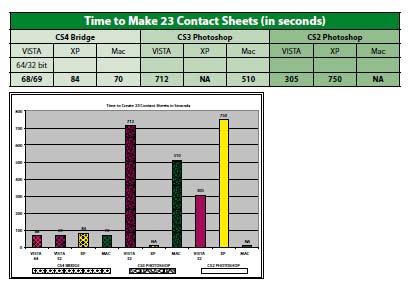
What does it all mean? Well CS4 is the obvious winner with massive
reductions on all platforms. The difference between 32-bit and 64-bit operation
is minimal in this test. The difference between Mac and PC is minimal in CS4 on
the high-end platforms, but the Mac is 30% quicker than Vista with CS3. Vista is
almost twice as quick as XP using CS2 but Vista using CS2 is twice as quick as
Vista using CS3! If your brain is now about to explode just take this nugget –
CS4, when it comes to contact sheet building, is massively quicker than
everything that has gone before.
The next trial was building a PDF for the magazine where we knew that the
memory 'page file limit' was going to be exceeded. When we make the PDF for the
magazine and we try to make more than 40 pages at a time, the program crashes in
both CS2 and CS3 (from InDesign). Nothing has changed, it still crashes with
CS4/Vista using 16GB of RAM and 8 processors. The only detectable difference was
that the program took slightly longer before it fell over.
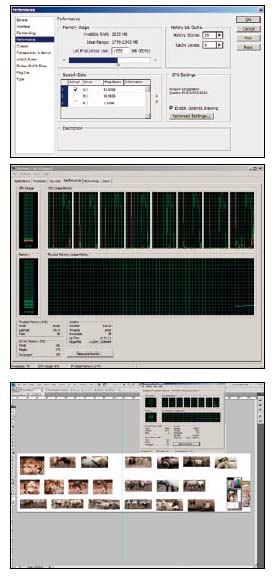
The next test we did was to apply Radial Blur to a 120MB file, using CS4 in both 32-bit and 64-bit modes. In both cases, all eight processors of the CPU appeared to be at work. The 64-bit version took 67 seconds, the 32- bit version took 74 seconds, a difference of about 10%. Nothing there to justify paying almost £3,000 for our monster work station.
Our final test consisted of assembling 20 images into a single large file, for printing. Each file was around 12MB and the assembled file was 545MB as layers and 267MB as a flattened file. This took 5.2 seconds to open as a 20-layer file with a Photoshop scratch file demand of between 2.02GB and 7.0GB as we worked on the file. We work files of this size on an occasional basis and it was the first time we noted that we were actually getting a real payback on all the RAM and processors we had installed. Photoshop allowed us to allocate 10GB of the 14.7GB available from the 16GB installed in the machine. There was some slowing of the machine during the manipulation of the assembly but nothing that troubled us.
Speed – the general feel
Tighter integration of the separate parts of the Adobe CS4 Suite is one of
the claims, rather than fancy new whistles and bells. For the graphic design
user this is important and defines how the program feels when in use. It is
difficult to put a metric on this 'feel' but an easy test is to time the program
start-up from cold. For some this may be a once-a-day activity and the timing
matters little, others have to move from program to program quite a lot. An
example is when a client phones to ask about something and you have to fire up a
computer to answer their query – the couple of minutes to start the OS and the
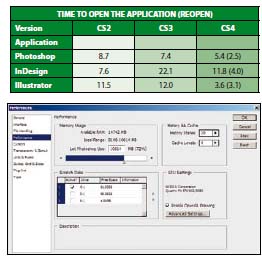
programs can seem like an eternity! This timing does indicate how tight the code
is and the CS4 applications are faster in every respect for both opening and
reopening the programs. InDesign CS4 is, however, slower than InDesign CS2 but
still twice as quick as InDesign CS3, suggesting that new functionality comes at
a price. The results are table on the next page.
Page 1 : Page 2 : Page 3 : Page 4 : Page 5 : Page 6 : Page 7
Find the Membership package for you:

Society of International Media & Press Photographers (SIMPP) is a trading name of BPPA Ltd
Clwyd Chambers, Clwyd Street, Rhyl, Denbighshire, LL18 3LA, UK
BPPA Ltd Company Reg 0392 2894
VAT number 790 4289 05
Tel: 01745 356935
Corporate Partners



Newsletter
Subscribe to the Societies Newsletter. Subscribe here.
Privacy. - Partner Societies - London Photography & Video Show - Europe's Largest 'All-Welcome' Photographic Convention