
On Matters of Resolution!

Light from an aperture is distorted by diffraction so that its intensity varies in the shape shown in the diagram. For a circular aperture this shape is revolved into a cone, with outlying rings of decreasing light intensity. This pattern is called an Airy disc after the physicist George Airy. When two resolvable patterns in an image get close to each other, such that the Airy discs overlap, the limiting resolution has been reached. In practical terms this might be when the image of two stars cannot be separated by a telescope (ie you cannot tell if you are looking on one bright star or two smaller ones) or you cannot separate two diatoms under the microscope. Closer to home, in a digital camera, the diffraction limit is reached when the Airy disc spans two pixel sites. If this sounds esoteric it is not – the diffraction limit for most cameras occurs between f8 and f16, so it is right in the territory that many photographers work. You can do nothing about this drop in resolution, it is not dependent upon either the cost or the quality of the lens. However, a poor lens will mask diffraction limiting because the shape and interaction of the Airy disc is further impeded by the residual aberrations. An additional complication is the design of the Bayer camera chip, which has twice as many green pixel sites as either blue or red. Red light starts to diffract first, then green then blue.
For the macro photographer, diffraction limiting is experienced faster and, in practice, more frequently. The effective aperture of the lens is reduced by increasing magnification, such that at 1:1 an aperture of f8 might seem to be safe but the effective aperture
depth of field we tend to use smaller and smaller apertures. However, after diffraction limiting is reached there will be no real increase on depth of field, just an overall softening of the image.
The foregoing has real implications for the choice of camera model, suddenly the pixel pitch is of paramount importance and the pixel count starts to look a little shaky – your Nikon D3x will reach diffraction limiting sooner than your Nikon D3. This is insignificant, perhaps, for social photography, but becomes a problem for scientific- and naturemacro work, when depth of field and resolution are important. The reality is not quite as gloomy as this might suggest but the difference between the D3x and D3 is almost exactly one stop, or, in depth of field terms, you can grab an extra 50% DoF before diffraction limiting kicks in – this might just be worth having! The problem with this analysis is that the difference will not all be realised if the lens is not perfect (and they never are of course). Camera shake could totally overwhelm the effect anyway, residual aberrations are always lurking.
One outcome of the analysis is that even the landscape photographer should prefer the use of carefully considered hyperfocal distance focusing rather than slamming in f22 and hoping for the best. It boils down to old-fashioned craftsmanship and understanding what is going on with your lens and camera. The optimum performance of a lens is likely to be achieved just before you get to the diffraction limited aperture, so it is as well to know just where it is!
At close macro distances the optimum aperture gets to be disappointingly wide if retention of detail is paramount. You need to be thinking in terms of f5.6 on the lens barrel. If your subject is smooth and lacking in detail you might push the loss of critical detail against the increase in depth of field to advantage and stop down a little more. Testing is, however, quite important in case your system is pushed right over the limit.
The designers of the camera companies are, of course, alert to these effects but have always to strive for the optimum balance of properties, lens corrections and chip sizes. It is only when the advertising guys get involved that the water gets muddied, as they search for market advantage – that is where we came in, engraving the pixel count on the front of the camera. It is also why compact cameras have similar pixel counts to professional DSLRs even though they are wrecked beyond repair if used beyond f8 – there are pixels and there are pixels and not all pixels are created equal!
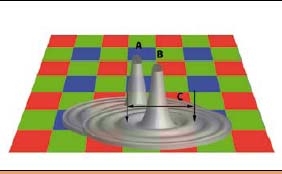
The plain graph shows the distribution of light energy coming from a narrow slit. Most of the light is concentrated in the centre, but there are outlying dark rings and light ones of gradually decreasing strength. When the light comes from a circular aperture, the pattern is revolved into the classic Airy Disc shape as depicted in the grey, 3-D model.
In digitial imaging the limit of resolution is reached when the Airy disc overlaps two or more pixel sites, ie the distance 'C'. When two points are imaged at that size, they 'merge' together and cannot be distinguished as separate points. Typically these could be two stars seen in a telescope.
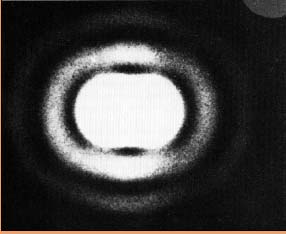
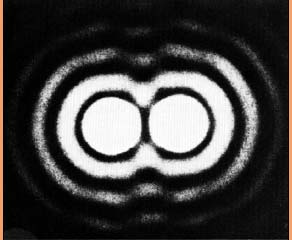
In the top image two Airy discs are just resolved, only the first black rings of the Airy discs are intersecting. In the lower image the Airy discs are too close and the two points are not resolved.
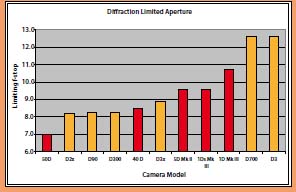
The diffraction limited aperure of a number of popular Nikon and Canon cameras.
Find the Membership package for you:

Society of International Media & Press Photographers (SIMPP) is a trading name of BPPA Ltd
Clwyd Chambers, Clwyd Street, Rhyl, Denbighshire, LL18 3LA, UK
BPPA Ltd Company Reg 0392 2894
VAT number 790 4289 05
Tel: 01745 356935
Corporate Partners



Newsletter
Subscribe to the Societies Newsletter. Subscribe here.
Privacy. - Partner Societies - London Photography & Video Show - Europe's Largest 'All-Welcome' Photographic Convention